Call us for a free consultation! 403.229.2774 |
  Email us at reception@canadianlegal.org
The Canadian Record Suspension Process
The Canadian Record Suspension Process
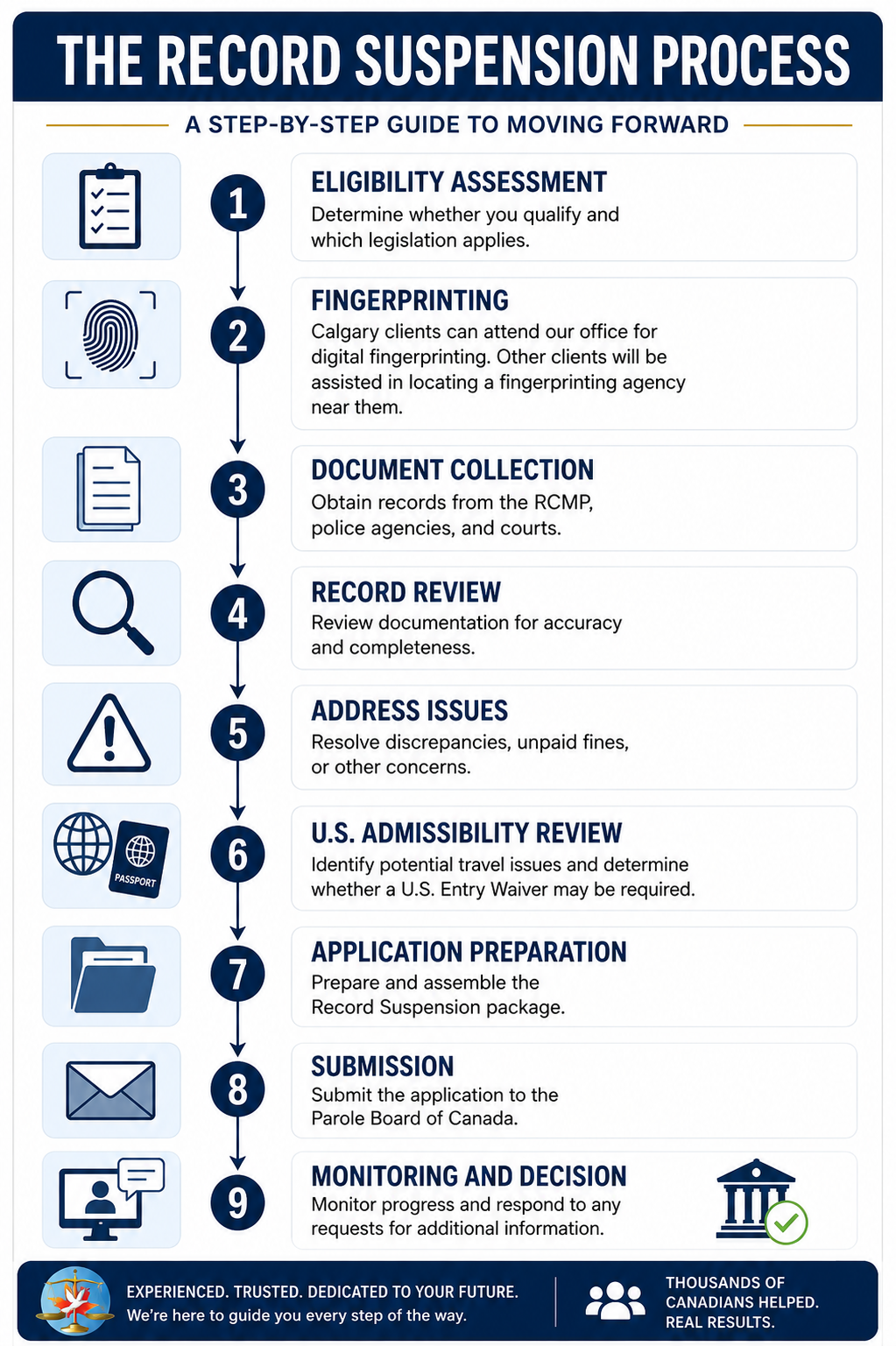
Your Step-by-Step Roadmap Applying for a Record Suspension, formerly known as a Canadian Pardon, can seem overwhelming. However, the process becomes much easier when you understand what happens at each stage.
Whether your goal is better employment opportunities, easier travel or simply peace of mind, following the proper process can help prevent avoidable delays and improve the likelihood of a successful application.
At Canadian Legal Resource Centre Inc., we have helped thousands of Canadians navigate the Record Suspension process. Here is what you can expect from start to finish.
The Record Suspension Process
A complete application normally moves through nine important stages. Each stage builds on the one before it, making accuracy and organization important from the beginning.
Step 1: Eligibility Assessment
Every successful application begins with determining whether you qualify.
Eligibility depends on several factors, including:
- The type of offence or offences
- When all parts of the sentence were completed
- Payment of all fines, surcharges and restitution
- Completion of probation or parole
- The waiting period established under the Criminal Records Act
Why the date of the offence matters
Record Suspension legislation has changed several times. The applicable rules may depend on when the offence occurred. Determining eligibility correctly at the beginning can prevent months of unnecessary work.
Step 2: Fingerprinting
Most Record Suspension applications require a certified RCMP criminal record check based on fingerprints.
If you are in Calgary, we can complete your digital fingerprints in our office. If you live elsewhere in Canada, we can help you locate an accredited fingerprinting agency near you.
Digital fingerprinting is fast, accurate and securely submitted to the RCMP for processing.
Step 3: Document Collection
Several official documents must be gathered before an application can be submitted. These commonly include:
- An RCMP criminal record
- Local police record checks
- Court information
- Proof that every part of the sentence has been completed
Obtaining these records may involve contacting several police services, courts and government agencies in different jurisdictions. Careful organization is especially important when a file involves more than one offence or location.
Step 4: Record Review
Once the documents have been received, each record should be reviewed carefully for accuracy and completeness.
Potential problems may include:
- Missing charges
- Incorrect conviction information
- Incomplete court records
- Inaccurate dates
- Missing dispositions or outcomes
Identifying and correcting discrepancies at this stage can prevent document requests and avoidable delays after the application has been submitted.
Step 5: Address Any Outstanding Issues
Before applying, any outstanding requirements connected to the sentence should be resolved.
Examples may include:
- Unpaid fines
- Victim surcharges
- Restitution orders
- Outstanding warrants
- Missing court documentation
A small issue can create a significant delay.
An unresolved balance or missing court record may affect eligibility or prevent the application from moving forward. These matters should be investigated before the final package is prepared.
Step 6: Review U.S. Travel Issues
Many people mistakenly believe that receiving a Canadian Record Suspension automatically restores their ability to enter the United States. Unfortunately, that is not always the case.
If information about the conviction has already been viewed or retained by United States authorities, a person may still require a U.S. Entry Waiver after receiving a Record Suspension.
Reviewing your travel and border history before submitting the application can help identify whether additional steps may be necessary.
Important travel distinction
A Record Suspension affects how a criminal record is maintained within Canada. It does not bind foreign governments or guarantee admission to another country.
Step 7: Prepare the Application
After the supporting records have been collected, reviewed and corrected, the formal application package can be prepared.
This involves:
- Completing all required forms
- Organizing the supporting records
- Ensuring information is consistent throughout the package
- Confirming that every required document has been included
A complete and carefully organized application reduces the risk of delays caused by missing, inconsistent or incomplete information.
Step 8: Submit to the Parole Board of Canada
Once complete, the application is submitted to the Parole Board of Canada, the federal agency responsible for making decisions on Record Suspension applications.
The Board reviews matters such as:
- Whether the eligibility requirements have been met
- The applicant’s conduct
- The completeness of the application
- The supporting documentation
Processing times can vary according to the nature and complexity of the application, whether further information is required and the Board’s current workload.
Step 9: Monitor Progress Until a Decision Is Made
Submitting the application is not necessarily the final administrative step. During its review, the Parole Board may request:
- Additional information
- Clarification of submitted documents
- Updated records
- Further supporting documentation
Monitoring the application and responding promptly to requests can help keep the file moving forward until a final decision is issued.
Why Professional Assistance Can Make a Difference
Individuals are permitted to apply for a Record Suspension without professional assistance. However, the process involves multiple agencies, detailed records and strict legislative requirements. Missing information or unresolved issues can significantly delay an application.
An experienced Record Suspension professional can help you:
- Determine your eligibility correctly
- Identify potential problems early
- Confirm that documentation is complete
- Prepare an accurate application package
- Monitor progress throughout the process
- Provide guidance when additional information is requested
For many applicants, professional assistance provides peace of mind and reduces the stress of navigating a complicated administrative process.
Frequently Asked Questions
Ready to Take the First Step?
If you are wondering whether you qualify for a Record Suspension, the best place to begin is with an eligibility assessment.
Canadian Legal Resource Centre Inc. has helped thousands of Canadians move beyond the barriers created by a criminal record. Our experienced team can guide you through every stage—from determining your eligibility to preparing the application and monitoring it until a decision is made.
Your past does not have to define your future. Taking the first step today could open the door to new opportunities tomorrow.
Your information is confidential and secure.
No obligation. No pressure. Free eligibility assessment.
Your Step-by-Step Roadmap Applying for a Record Suspension, formerly known as a Canadian Pardon, can seem overwhelming. However, the process becomes much easier when you understand what happens at each stage.
Whether your goal is better employment opportunities, easier travel or simply peace of mind, following the proper process can help prevent avoidable delays and improve the likelihood of a successful application.
At Canadian Legal Resource Centre Inc., we have helped thousands of Canadians navigate the Record Suspension process. Here is what you can expect from start to finish.
The Record Suspension Process
A complete application normally moves through nine important stages. Each stage builds on the one before it, making accuracy and organization important from the beginning.
Step 1: Eligibility Assessment
Every successful application begins with determining whether you qualify.
Eligibility depends on several factors, including:
- The type of offence or offences
- When all parts of the sentence were completed
- Payment of all fines, surcharges and restitution
- Completion of probation or parole
- The waiting period established under the Criminal Records Act
Why the date of the offence matters
Record Suspension legislation has changed several times. The applicable rules may depend on when the offence occurred. Determining eligibility correctly at the beginning can prevent months of unnecessary work.
Step 2: Fingerprinting
Most Record Suspension applications require a certified RCMP criminal record check based on fingerprints.
If you are in Calgary, we can complete your digital fingerprints in our office. If you live elsewhere in Canada, we can help you locate an accredited fingerprinting agency near you.
Digital fingerprinting is fast, accurate and securely submitted to the RCMP for processing.
Step 3: Document Collection
Several official documents must be gathered before an application can be submitted. These commonly include:
- An RCMP criminal record
- Local police record checks
- Court information
- Proof that every part of the sentence has been completed
Obtaining these records may involve contacting several police services, courts and government agencies in different jurisdictions. Careful organization is especially important when a file involves more than one offence or location.
Step 4: Record Review
Once the documents have been received, each record should be reviewed carefully for accuracy and completeness.
Potential problems may include:
- Missing charges
- Incorrect conviction information
- Incomplete court records
- Inaccurate dates
- Missing dispositions or outcomes
Identifying and correcting discrepancies at this stage can prevent document requests and avoidable delays after the application has been submitted.
Step 5: Address Any Outstanding Issues
Before applying, any outstanding requirements connected to the sentence should be resolved.
Examples may include:
- Unpaid fines
- Victim surcharges
- Restitution orders
- Outstanding warrants
- Missing court documentation
A small issue can create a significant delay.
An unresolved balance or missing court record may affect eligibility or prevent the application from moving forward. These matters should be investigated before the final package is prepared.
Step 6: Review U.S. Travel Issues
Many people mistakenly believe that receiving a Canadian Record Suspension automatically restores their ability to enter the United States. Unfortunately, that is not always the case.
If information about the conviction has already been viewed or retained by United States authorities, a person may still require a U.S. Entry Waiver after receiving a Record Suspension.
Reviewing your travel and border history before submitting the application can help identify whether additional steps may be necessary.
Important travel distinction
A Record Suspension affects how a criminal record is maintained within Canada. It does not bind foreign governments or guarantee admission to another country.
Step 7: Prepare the Application
After the supporting records have been collected, reviewed and corrected, the formal application package can be prepared.
This involves:
- Completing all required forms
- Organizing the supporting records
- Ensuring information is consistent throughout the package
- Confirming that every required document has been included
A complete and carefully organized application reduces the risk of delays caused by missing, inconsistent or incomplete information.
Step 8: Submit to the Parole Board of Canada
Once complete, the application is submitted to the Parole Board of Canada, the federal agency responsible for making decisions on Record Suspension applications.
The Board reviews matters such as:
- Whether the eligibility requirements have been met
- The applicant’s conduct
- The completeness of the application
- The supporting documentation
Processing times can vary according to the nature and complexity of the application, whether further information is required and the Board’s current workload.
Step 9: Monitor Progress Until a Decision Is Made
Submitting the application is not necessarily the final administrative step. During its review, the Parole Board may request:
- Additional information
- Clarification of submitted documents
- Updated records
- Further supporting documentation
Monitoring the application and responding promptly to requests can help keep the file moving forward until a final decision is issued.
Why Professional Assistance Can Make a Difference
Individuals are permitted to apply for a Record Suspension without professional assistance. However, the process involves multiple agencies, detailed records and strict legislative requirements. Missing information or unresolved issues can significantly delay an application.
An experienced Record Suspension professional can help you:
- Determine your eligibility correctly
- Identify potential problems early
- Confirm that documentation is complete
- Prepare an accurate application package
- Monitor progress throughout the process
- Provide guidance when additional information is requested
For many applicants, professional assistance provides peace of mind and reduces the stress of navigating a complicated administrative process.
Frequently Asked Questions
Ready to Take the First Step?
If you are wondering whether you qualify for a Record Suspension, the best place to begin is with an eligibility assessment.
Canadian Legal Resource Centre Inc. has helped thousands of Canadians move beyond the barriers created by a criminal record. Our experienced team can guide you through every stage—from determining your eligibility to preparing the application and monitoring it until a decision is made.
Your past does not have to define your future. Taking the first step today could open the door to new opportunities tomorrow.
Your information is confidential and secure.
No obligation. No pressure. Free eligibility assessment.